Overcoming barriers
The prestigious 'King Hamad Bin Isa Al-Khalifa Prize on Innovation in Education' from UNESCO (United Nations Educational, Scientific and Cultural Organization) is awarded yearly to ICT projects that overcome major situational barriers - such as lack of infrastructure and funds - to deliver a tailor-made solution based on children’s realities.
Ground-breaking
Can’t Wait to Learn’s educational methodology was built on these foundations. The programme - developed by us in collaboration with (inter)national partners such as UNICEF, Ministries of Education and &Ranj - provides conflict-affected children with quality education.
Celebrated by UNESCO for its ground-breaking use of new technologies, Can't Wait to Learn teaches children how to read, write and count by playing educational games on tablet devices. In conflict-affected areas - where access to schools and teachers is limited - children don’t have to wait to gain skills for the future.
“Even in contexts with limited resources and services, children can keep on learning. This is all thanks to an effective, flexible and innovative method, based on official curricula which aims to support children in gaining important maths and reading competencies and access to further education opportunities."
Kate Radford, CWTL Programme Director

Children in Lebanon playing one of the educational games
Photo: War Child

Solar panels are used to charge the educational tablets
Photo: War Child
Quality education, regardless of the setting
So what sets Can’t Wait to Learn apart? The answer is surprisingly simple. Thanks to a delivery system which can operate in areas with limited resources, such as electricity and internet, Can’t Wait to Learn provides learning opportunities for all. The programme enables children to learn even in places where formal education is not available or under strain.
The secret ingredient: designed for children, by children
Can’t Wait to Learn is not based on a 'one size fits all' model. The children co-create the content and design of the games based on their own experiences and stories. The content - which is based on government-approved educational curricula - allows children to become immersed in a world that reflects their reality - and focus right away. Research has shown that this facilitates effective learning and boosts motivation.
Each educational game is developed using the following seven steps:
1. Co-creation
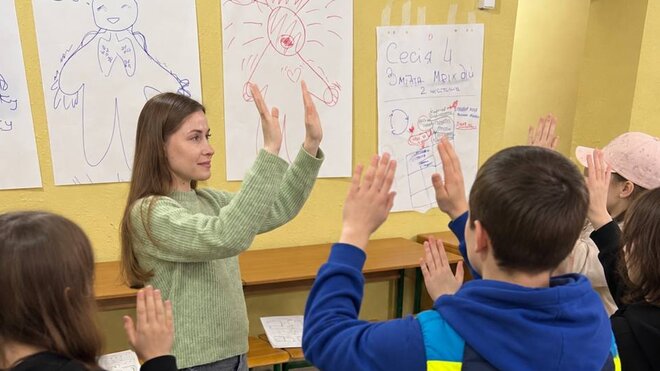
The individual needs of children are identified through Needs Assessment Research led by focus groups. Using drawings, clay and Lego, children show what’s important to them and what their living environment looks like.
2. Local artists
Local artists use these creative expressions to draw their sketches. These are then submitted to the children for feedback. Eventually the sketches are used for the design of the games and the characters.
3. Content of the game
All of the game content is based on government-approved school curricula - forging a pathway through primary level education and beyond. In this way Can’t Wait to Learn supports the existing education system, rather than replacing it or imposing an external solution.
4. Development of the game
The curricula-based content is then translated into step-by-step videos and audio instructions with a narrative that the children can have fun with. This is when the technical programming of the game is developed. For example, the portal that allows the management of the tablets, and the system that allows teachers to follow the children’s learning progress.
5. Implementation
Can’t Wait to Learn trains employees, facilitators and teachers in working with tablets. In addition, War Child trains staff to solve some of the technical problems that might arise. Difficulties that might be caused by a lack of electricity or internet are minimized by installing solar panels and creating charge points. Staff are also taught how to update the software that can be used offline.
6. Playtime
Children can play the educational games. Their progress is closely monitored and their feedback taken into account for later iterations of the games.
7. Quality
In this phase, evaluation and feedback are central - both on technical aspects and on game content. Researchers also map the effect Can’t Wait To Learn has on the development of children and their learning progresses. With these findings, the game and its delivery are adapted and improved, so that the quality of the education is safe-guarded.
Award ceremony
The prestigious prize will be presented at the UNESCO headquarters in Paris on March 12th, 2019 in the presence of delegates of the Kingdom of Bahrain. On behalf of War Child, Can’t Wait to Learn Programme Director Kate Radford will attend the celebrations.
Can’t Wait to Learn supporters include the Dutch National Postcode Lottery; IKEA Foundation; Google.org; USAID; DFID through the Humanitarian Education Accelerator; DG ECHO; UNICEF; UNHCR; CISCO Foundation; Mission Bambini and private donations.