From Idea to Innovation: Building the Can’t Wait to Learn Phonics Curriculum
Sept. 30, 2025
Learning from Early Lessons
The idea of teaching children to spell and read through a game came with big challenges. The first experiments showed children could learn mathematics through applied gaming with minimal support. But literacy turned out to be a bit more complex for a variety of reasons.
Early pilots in Sudan, Jordan, and Lebanon demonstrated that children could learn the letters but not necessarily progress to spell accurately or read fluently. As Glenn McCance, our Global Content and Teacher Training Specialist, recalls:
“We had seen results from our Arabic games where children learned the alphabet but could not read or spell adequately by the end because we had not provided the essential bridge between learning individual letters and explicitly teaching children how to blend and segment words.
This experience taught us that alphabetic knowledge alone was insufficient without systematic instruction in phoneme-grapheme correspondence – connecting sounds with written symbols, while also providing many opportunities to manipulate those sounds.”
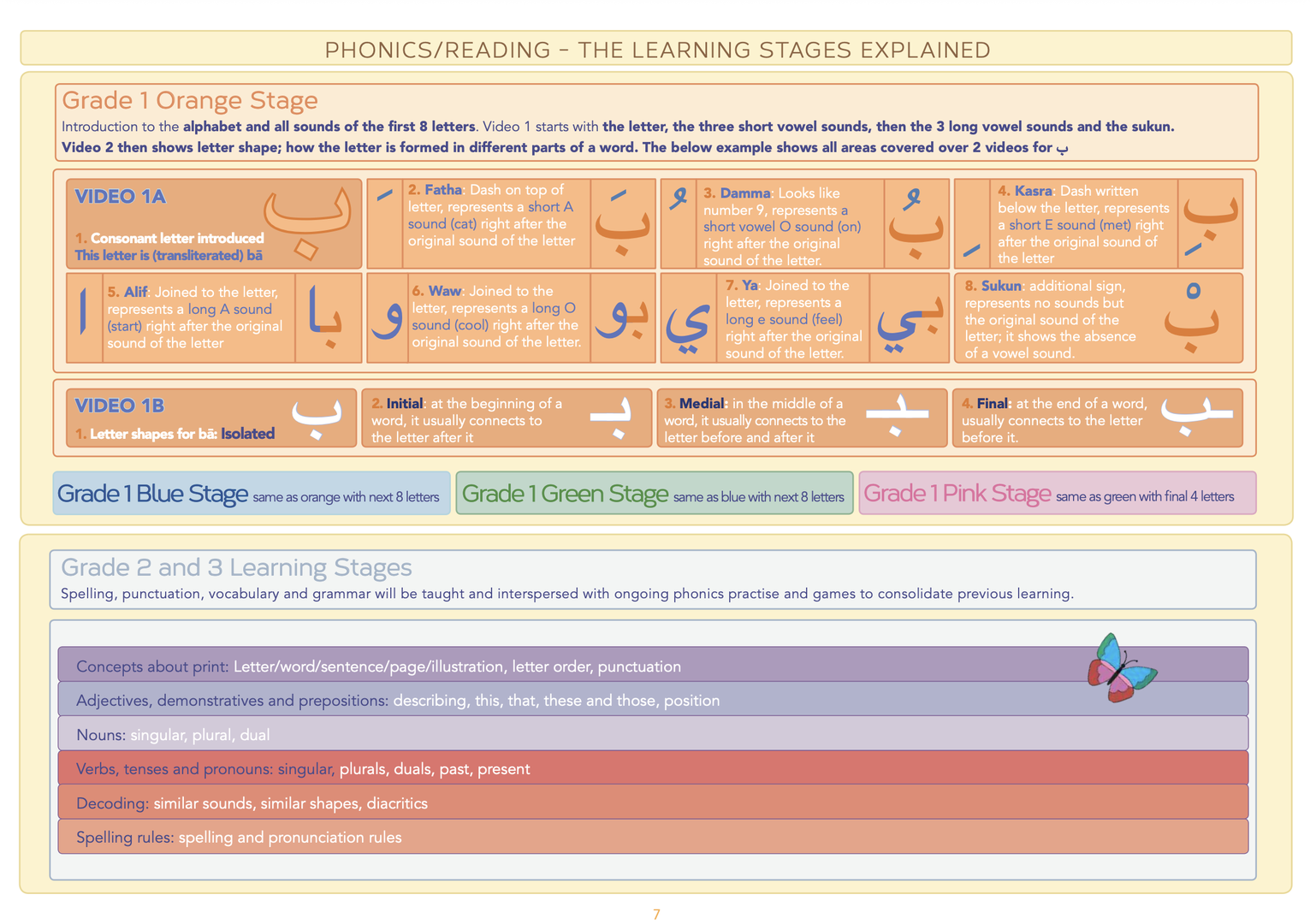
Phonics/Reading Arabic basics. Can’t Wait to Learn Phonics/Reading Programmes English/French/Arabic.
The team also observed what they referred to as “learning plateaus”, moments where children’s progress stalled. Unlike a teacher, an offline digital game cannot adapt on the spot. Every possible learning path had to be anticipated in advance. This required building highly structured content so that children could move forward without getting stuck. As Glenn explains:
"Digital learning cannot always be exactly the same as with a teacher in a classroom. We had to translate what works face-to-face into something that works consistently on a tablet."
The challenge evolved when moving beyond foundational "access" to literacy (spelling and reading) toward "agency" in written expression. As experienced educators, we know that teaching children to plan, write, and edit their own fiction and non-fiction texts is difficult even in well-resourced classrooms; in offline settings, with no way to provide dynamic feedback, it seemed nearly impossible. Only in recent years, with advances in artificial intelligence, has this barrier begun to shift dramatically.
Our Secret Ingredient: Co-creation
The turning point came with the first English phonics game, released in Uganda in 2018. The breakthrough was placing systematic synthetic phonics at the core: explicitly teaching blending (putting sounds together) and segmenting (pulling sounds apart), so learners can begin to read and spell as quickly as possible.
This process relied not only on research but also on co-creation with children, ministries, and local creatives. All content was paired with culturally relevant images and stories that reflected children’s realities and aspirations. Fun, story driven instruction videos were made with a phonics organisation from Northern Uganda who trained local actors in internationally recognised best practise for phonics instruction, and a film production crew from Kampala. Letters were introduced in a deliberate sequence so children could experience the excitement and motivation of spelling and reading simple words very quickly on in their learning journey.
Working hand-in-hand with ministries also reinforced that “alignment” does not always mean simply copying a curriculum onto a tablet. Instead, it meant designing digital learning pathways that respected national standards while focusing only on objectives that could be effectively taught with EdTech – not just including content because it appears in a curriculum document.
From that point, every literacy game we have now developed in four languages incorporates activities where learners experiment and play with sounds, syllables and letter combinations – gradually moving from recognition to confident reading.
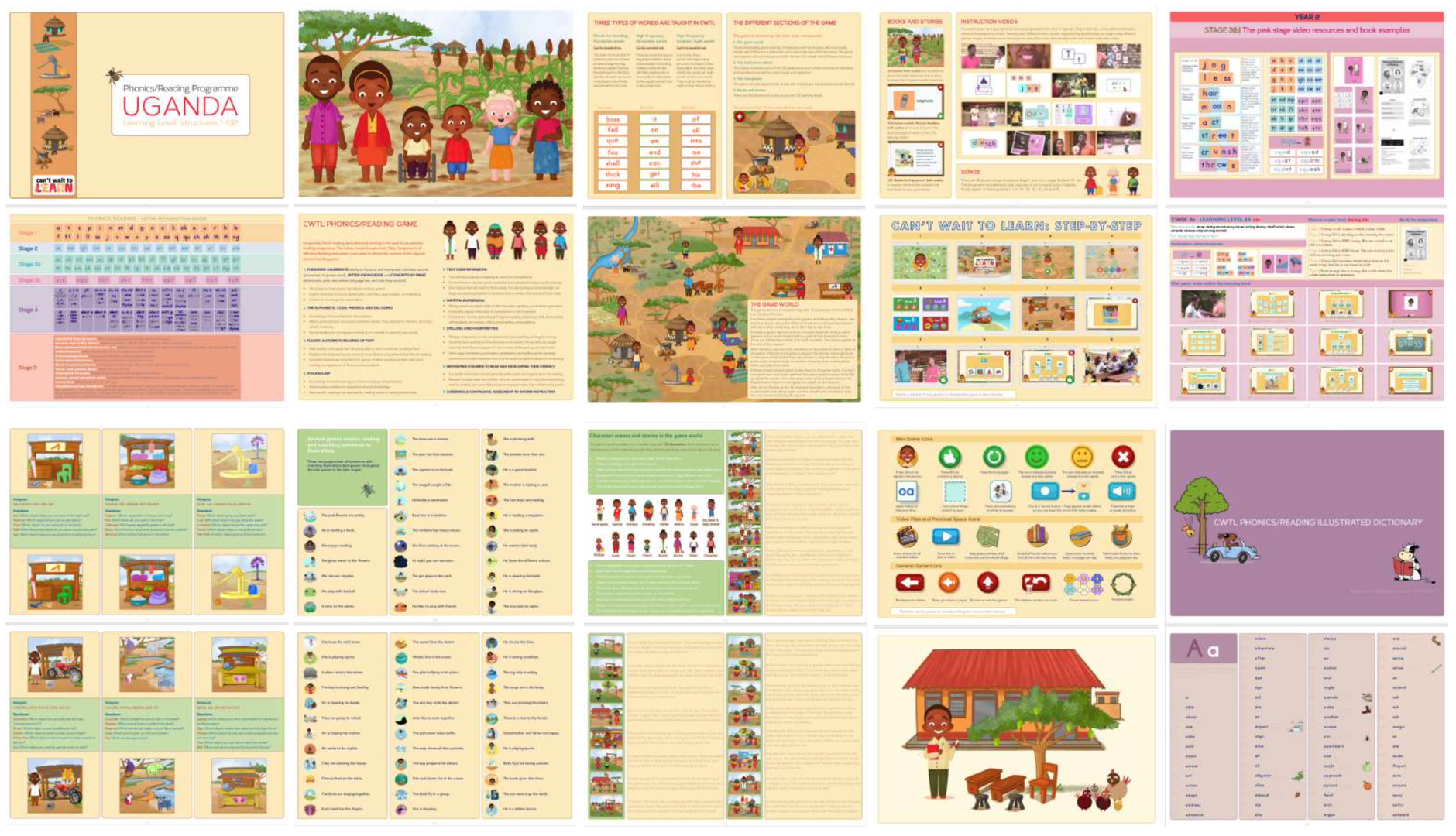
A sample from the full Can’t Wait to Learn Uganda curriculum content document that shows methodology, stories and exactly what content is found in every learning level of the game.
The Key to Success: Continuous Iteration and Evidence
The phonics curriculum was never built once and left untouched. It has been constantly refined through pilots, peer-reviewed research, and classroom evidence. Key lessons included:
- Quality over quantity: fewer, better-designed activities for active phonemic exploration worked better than more drill-and-practice content that assumed existing competency.
- Curriculum scrutiny: every objective had to be tested for whether it could be effectively taught digitally.
- Pedagogy before technology: the learning goals always led the design, not the other way around.
Glenn sums it up:
“Our role is to use our expertise to contribute meaningfully to education systems through evidence-based practice, rather than simply implementing what we find in a particular curriculum. We work collaboratively with local education specialists and methodologists, so we get the best product that benefits children’s learning outcomes and gives them the best possible foundation for their future learning success.”
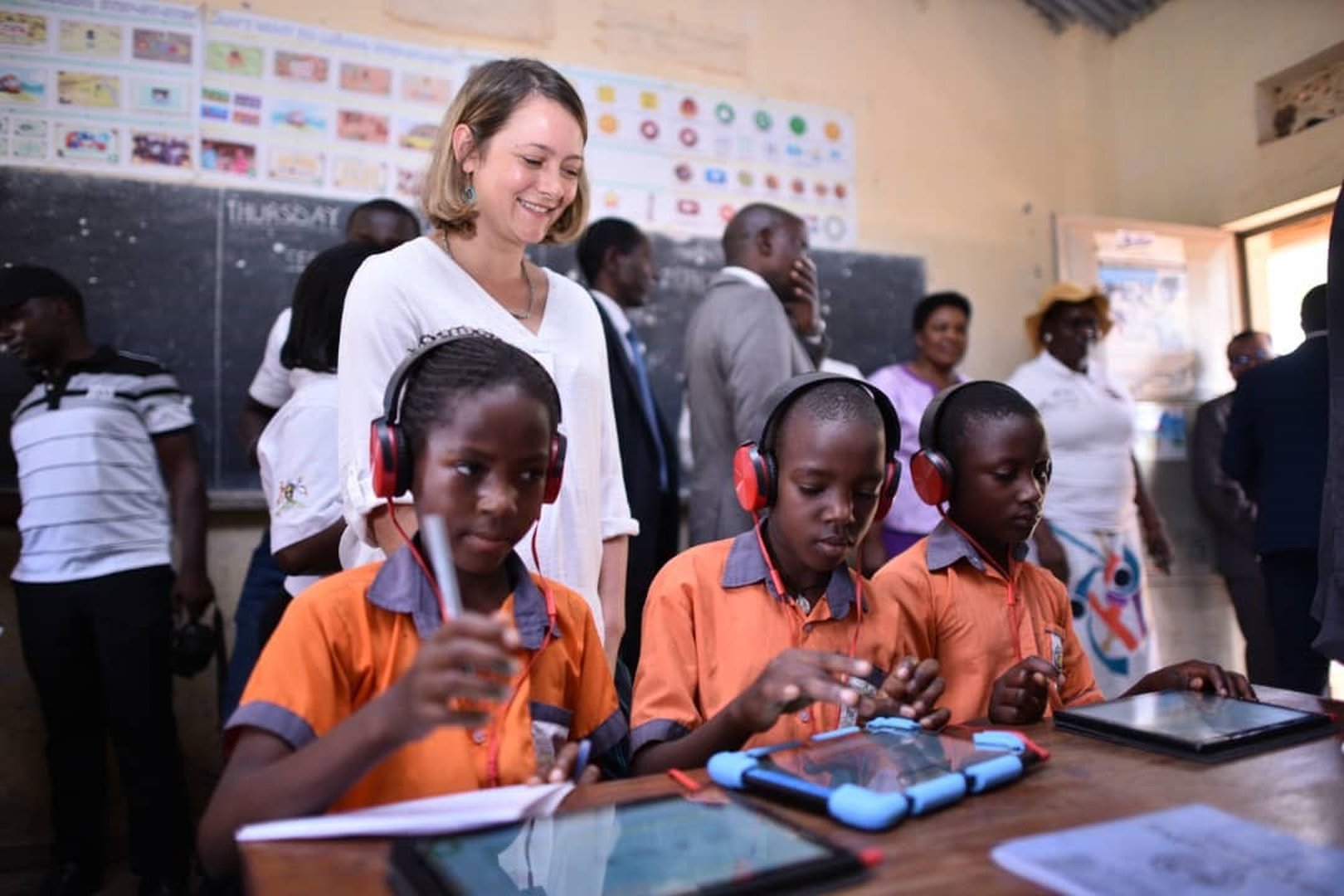
In Uganda, we used a cluster randomised control trial (cRTC) to compare Can’t Wait to Learn’s digital personalised learning with traditional classroom teaching.
Photo: War Child
Learning with Confidence
Although designed for independent use, the games follow mastery principles: learners must demonstrate understanding before moving forward. Built-in assessments provide instant feedback, even offline.
For teachers, the system offers valuable insights into learners’ strengths and struggles, making it both a classroom resource and a formative assessment tool that supports professional growth.
At the same time, reading is never treated as a chore. Children play mini games, explore interactive stories, and encounter characters and content that feel familiar and joyful. Motivation stays high because learning feels like an adventure.
Pushing Boundaries with AI: From Feedback to Creativity
Until now, Can’t Wait to Learn has shown how children can master the building blocks of reading and spelling through systematic phonics and carefully sequenced activities. But literacy is more than spelling and decoding — it’s about being able to generate and share ideas.
That’s where artificial intelligence opens new possibilities. The team is exploring how AI can act not just as a corrective tool, but as a responsive literacy companion that can:
- spark imagination through prompts
- model different types of writing (from simple stories to letters and reports)
- provide real-time guidance that goes beyond “right” or “wrong”, helping learners improve coherence, structure, and style.
In contexts where teachers are scarce, this could be truly transformative. AI can give children the confidence to experiment with writing, fostering not only functional literacy but also a sense of authorship and agency. As Glenn reflects:
“We are in the process of experimenting with AI as an adaptive literacy companion that supports creative writing, models good practice and matches instruction to each learner’s ability level. It can enhance engagement by providing clear, targeted individual feedback that motivates learners and accelerates their progress.”
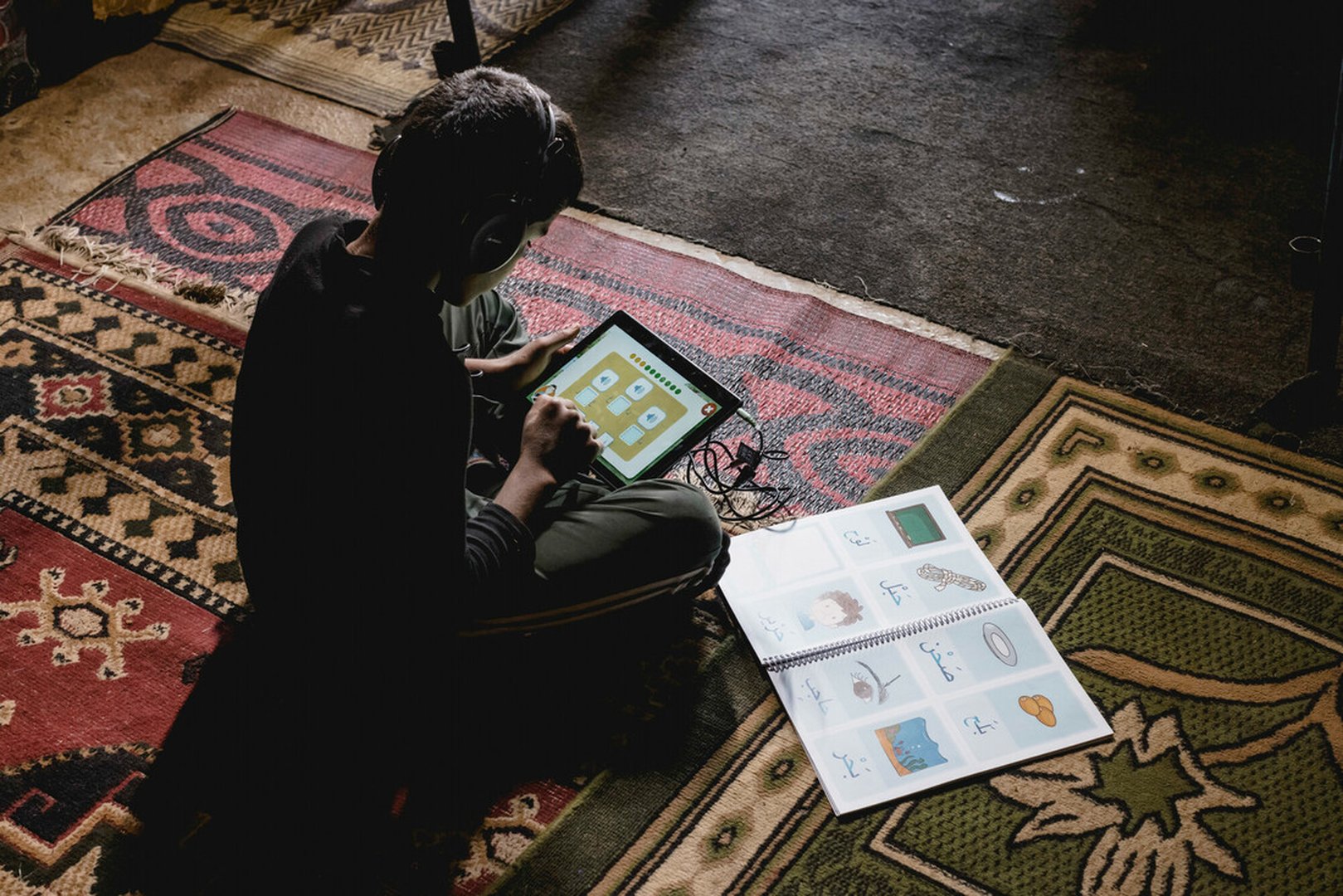
Boy learning phonics/reading through Can’t Wait to Learn at home in Lebanon.
Photo: Ralph Dargham/War Child
The journey from idea to innovation shows that digital learning can do more than deliver content; it can empower children to become confident readers and writers, even in the most challenging contexts. By combining evidence-based phonics, culturally relevant stories, and emerging AI tools, Can’t Wait to Learn is not just teaching literacy, it is giving children the tools to create, explore, and own their learning journey.
Don’t miss your chance to join the game!
Subscribe to our LinkedIn newsletter and be part of our journey to scale digital, personalised learning for children in crisis-affected areas worldwide.
Partner with us
Join our mission to improve the lives of crisis-affected children through educational innovation. Whether you represent a government body, research institution, private organisation, or are simply passionate about education, technology, and children’s well-being, your collaboration can help us reach even more vulnerable learners.
Together, we can provide the tools, resources, and opportunities children and teachers need to build brighter futures – even in the toughest contexts. Contact our Programme Director Luke Stannard at luke.stannard@warchild.net.