Navigating Research During Wartime: Evaluating the Can’t Wait to Learn Ukraine Programme
Nov. 6, 2025
Conducting research in conflict and war settings demands deep contextual knowledge, resilience, and ethical integrity. For the first interview in our new R&D spotlight series, we hear from someone who embodies these qualities: Oksana Zabolotna, a Research Coordinator at War Child Alliance’s R&D Department and a Professor who is leading our research on the Can’t Wait to Learn programme in her home country. Launched in September 2022, Can't Wait to Learn Ukraine, locally known as "Вивчаю Не Чекаю", is a free application developed with Osvitoria and the Ministry of Education and Science of Ukraine. It offers curriculum-aligned games to support children's reading and numeracy on digital devices, which are available offline.
In this interview, Oksana offers her unique insights into the realities of this work, discussing the practical and ethical challenges of generating evidence to improve learning outcomes for children during the ongoing war.
Could you please introduce yourself and tell us about the research you are conducting in Ukraine?
My name is Oksana Zabolotna. I am a Professor of Pedagogical Sciences and a Research Coordinator for War Child’s R&D Department in Ukraine.
We are currently evaluating the Can’t Wait to Learn Ukraine programme to understand how it helps mitigate learning loss for children affected by the war. Due to the devastating impact of the war, children have missed significant learning opportunities, and our research aims to assess how this application supports them.
Our key research questions include 1) how the programme influences numeracy and literacy competencies among Ukrainian children, 2) what effects it has on their overall wellbeing, and 3) what are the strategies to scale up the programme in the future in Ukraine and beyond?
Our research is taking place in the Cherkasy region. We selected this area because its central location is home to many families displaced by the conflict, which allows us to understand the programme’s impact in a community that reflects the broader realities of the war. Another reason for selecting this region was its distance from the front line; however, the fieldwork quickly revealed that this didn’t guarantee the absence of danger.
Could you walk us through a typical day for your research team during data collection?
A typical day for our research team is highly variable, depending on our destination, but it often starts quite early. For distant sites, we usually wake up around four in the morning to arrive at schools at eight to begin the interviews on time.
Once onsite, we work in the school until the very last student departs, as we are never sure what the next day will bring. Our work sometimes requires us to move between classrooms and shelters. In situations demanding rapid deployment or efficiency, our researchers support each other by working in the same location; this helps us not to miss anyone.
At the end of the day, the team typically connects via a video call to share impressions and reflect on the day’s work before uploading all collected data into the system. When a location is far from home, we often stay overnight to minimise travel time the next day.
Can you describe the experience of being on the ground during data collection? What struck you and your team about the environment and your interactions with children and communities?
Travelling to Ukraine is not particularly popular among tourists at the moment, but researchers are not tourists. For those who do visit, the most common way to enter the country is by train. In our case here in central Ukraine, travelling across the Cherkasy region is best done by car. That said, some of the schools included in our study are located in areas with less-than-ideal roads. We had 12 researchers working in four teams. Even though most of our team members are based in the Cherkasy region, many of us have never visited some of the small towns and villages where this research project has taken us.
One of the things that truly surprised us was how beautiful and well-maintained many of the schools were. Teachers, students, and school leaders spoke about their schools with immense pride and care, and that sense of dedication is evident in the way they have presented and improved their learning environments. Even in the time of war, we were pleasantly surprised to hear good mornings from every student we met.
Walking through the schools, one could almost forget about the war—if not for their heartbreaking reminders, portraits of young men and women who once walked through these corridors but later lost their lives defending Ukraine. So, they reminded us of the reality of the war.
Another deeply moving moment came each morning exactly at 09:00, when the entire school stood up in a minute of silence, remembering the thousands of innocent people who died in the war so far. Despite these painful realities, we felt the resilience and the positive spirit of the school communities, which was incredibly moving.
What were your primary concerns or fears leading up to the research activities, given the ongoing situation in Ukraine?
For data collection activities, so far, we have covered about 5000 kilometres. The greatest source of anxiety during our fieldwork was the mass drone attacks that occurred every night across all districts. In all districts of the Cherkasy region, with our team working in different locations, it was impossible to sleep soundly. I was constantly checking the Air Raid Alert mobile application. This is what every person in Ukraine has on their phones, which tracks active threats and highlights areas that are under attack, so it informs us. Instead of resting and sleeping, I spent many nights anxiously monitoring the situation and praying that no one would get hurt.
Another major concern was whether the air raid alarms would subside during the start of the school day. In some cities, if the air raid alert is active when the first lesson ends, students stay at home and instead switch to online learning. This means that after travelling 200 or 250 kilometres to reach a school [for data collection], there was always the possibility that there would be no children there at all, which would make the data collection impossible.
Despite these worries, we persevered with the research because we felt that the anticipated benefits for children’s learning and for the future of Ukrainian education outweighed the risks.
Did you encounter any unexpected challenges during data collection? How did your team navigate it, and what advice would you offer to other researchers working in similar contexts?
While conducting research, predictability is very important. That's why we planned field visits with great attention to every detail, coordinating with teachers and the school leadership teams in advance. Despite all this preparation, we found ourselves facing an unexpected challenge the night before a scheduled visit. We learned that the school had abruptly switched to online learning due to a pneumonia outbreak. Many children had been hospitalised, and a similar situation was unfolding at another school we planned to visit next.
At this moment, we had to completely rework our plans, adjust schedules, reroute our team, and figure out how to proceed in the rapidly changing conditions. But beyond the logistical challenges, what mattered most was the wellbeing of the children, and our primary concern was for them to recover and return to school safely.
My best advice for researchers working in unpredictable and complex environments is to avoid making overly rigid or ambitious plans. Flexibility is essential in a country at war; anything can happen, and last-minute changes are inevitable. The key is to be adaptable, embrace uncertainty, and not take disruptions too personally. This is simply the reality of fieldwork in such conditions.
How did you and your team manage the emotional burden of witnessing the impact of war firsthand? What advice would you give to others in similar circumstances?
The context in which we conduct the research is not so different from where we all actually live and our everyday lives. We organised ourselves into four teams of three people, which was essential for providing mutual support. Knowing that we weren't alone made a significant difference; we always felt the support of our team members. We communicated often, discussing the emotional aspects of the work and the impact our interactions with children had. Those moments of connection brought us joy and reminded us of the positive side of what we are doing. Our unique bond as a team even allowed us to create a kind of meta-language that those outside the group might not fully understand.
Additionally, we also found humour to be a vital coping mechanism. We were able to share jokes and laugh together, which brought some lightness to our work. There were inside references that only team members would understand.
The research team gears up for data collection in Ukraine
What was the biggest challenge you and your team faced, and what did you learn about conducting research in war settings? How has this experience changed your perspective on the role of research in humanitarian contexts?
The biggest challenge was the constant worry about home when you’re not there. Women often feel like umbrellas, trying to protect their families and homes, or like they’re spreading their wings to shield everyone. Yet, when there’s a drone or missile attack, they can feel helpless from afar. It’s terrifying to be distant and unable to protect your loved ones, almost as if you left your sick child at home unprotected—an emotionally overwhelming experience. This situation has profoundly changed my perspective on family roles and motivated me to plan my work more effectively so I can spend more time with them. With the numerous nighttime drone attacks on civilians, saying goodnight to loved ones becomes fraught with uncertainty; you can’t be sure you’ll have the chance to say good morning. That’s why we cherish our time with family.
This experience has also reshaped my understanding of the importance of research in humanitarian contexts. Our research is crucial because it examines the impact of educational solutions on children, who are our top priority.
When you introduced the research to children, teachers, caregivers, and parents, was there excitement or reluctance to participate?
Is there ever a perfect time for anything? The best time to start something is today. We, of course, relied on the schools’ willingness to participate. We began by disseminating information about the research and invited schools to apply for participation. The schools chose to apply, and we then randomly selected children to take part in the study, dividing them into treatment and comparison groups. Informed, voluntary consent and assent were collected from caregivers and children, but the initial decision to participate was made by the schools and teachers. Naturally, all schools wanted to be intervention schools; however, we gave the comparison schools the chance to implement Can't Wait to Learn after the endline study.
It was not easy to explain and convince the caregivers and parents of the benefits of participating in the study. However, once they downloaded the application, which is free, onto their devices, they were convinced. They saw the game characters and how the materials were arranged, and they were very enthusiastic about it. The first time the children were allowed to bring gadgets and use them [in the classroom] made their time. That is why the best way to persuade parents is to make their children happy.
Can you share a particularly memorable story about a person, a child, or a parent you met during data collection?
Yes – I vividly picture it before my eyes. During our initial pilot study, we visited a primary school just before the Christmas holidays. At that time, schools were holding festive performances, with children dressed in beautiful Christmas costumes. Little girls were dressed as princesses and fairies, while the boys wore festive outfits. The atmosphere was filled with joy, warmth, and dwindling holiday lights, but then? In the middle of the celebration, the air raid siren went off. I will never forget the sight of those children wearing their bright costumes, suddenly leaving the brightly lit holiday hall, and descending into a stark concrete bomb shelter. The contrast was devastating - joy and innocence abruptly interrupted by the harsh reality of war.
No child should ever have to experience something like this. No child should be forced to trade fairy lights for concrete walls or joyful holiday songs for the sound of sirens. Children should be free from the burdens of war. This moment will stay with me forever, and I truly believe that.
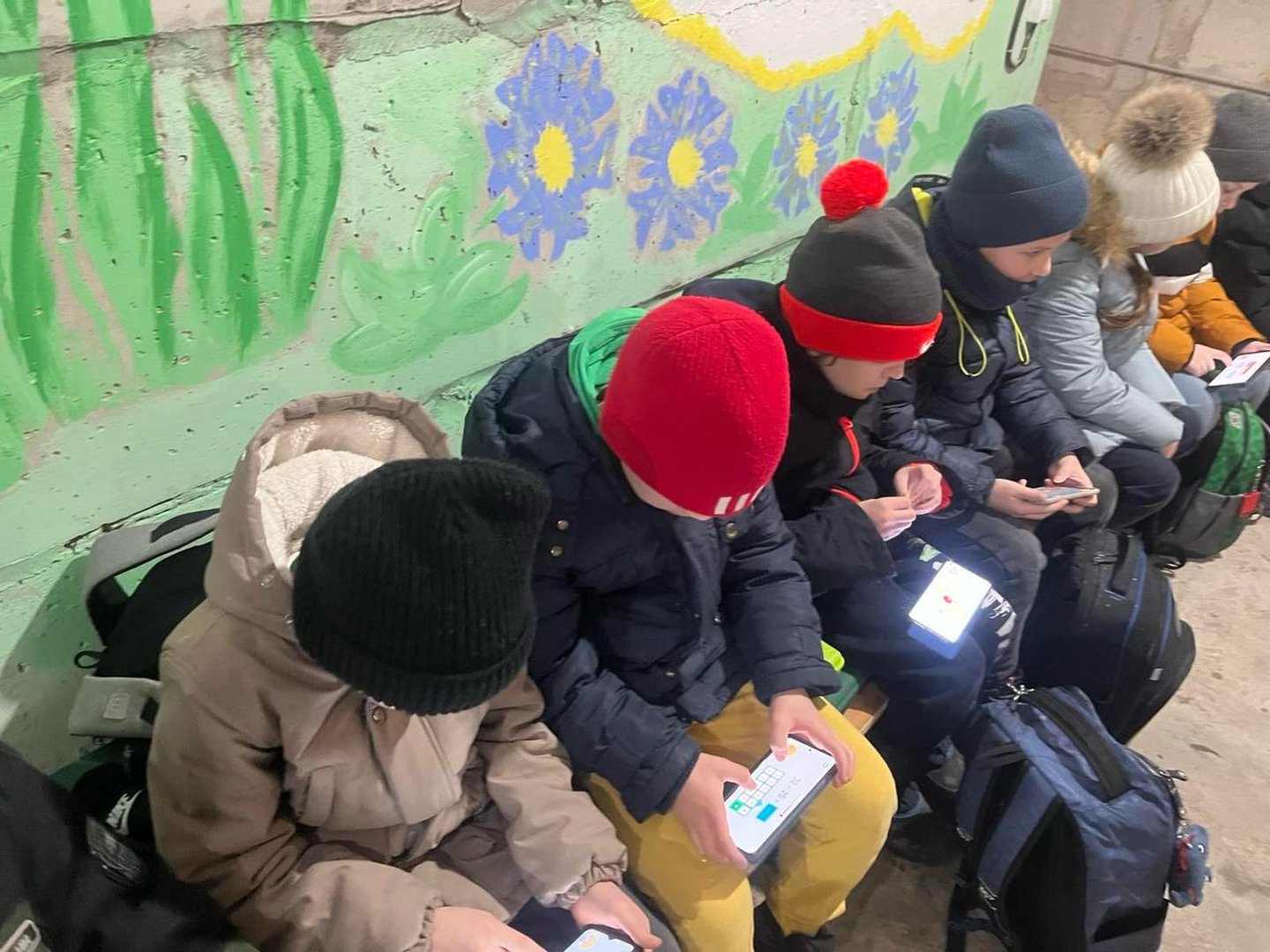
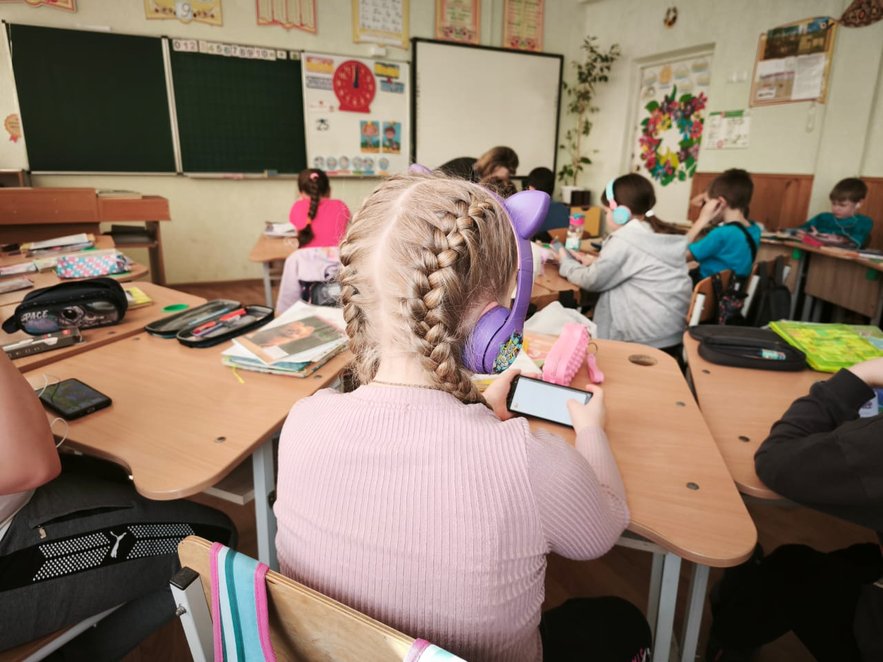
Amidst the threat of drone attacks, children find a moment of learning with 'Can't Wait to Learn' app on their gadgets in a shelter.
Your research team is predominantly women. Could you tell us about your experience working with this team composition and how your observations of the team relate to the broader impact of war on both women and children in Ukraine?
Yes, I want everyone who reads this interview to recognise the significant burden that war places on women and children. While men are fighting on the front lines, women must become even stronger, shouldering double responsibilities. They care for children, support their families, and make difficult choices for survival - all while dealing with trauma. Children also endure immense emotional and physical hardships, forcing them to grow up way too fast. With Can't Wait to Learn, we hope to bring them a little bit of their childhood back and fill the classroom with the joy of learning.
Our research team is primarily made up of women, with only one man. The women in our team have taken on responsibilities they never thought they could handle, proving that they are capable of much more than society often imagines. They are used to driving children to school and bringing them home within the cities they live in, but this time, they had to cover hundreds of kilometres for our research activities, trying to navigate the roads where navigation devices don’t work. They don’t work during drone attacks for protection purposes. So, they learned to do it, and I'm really proud of them.

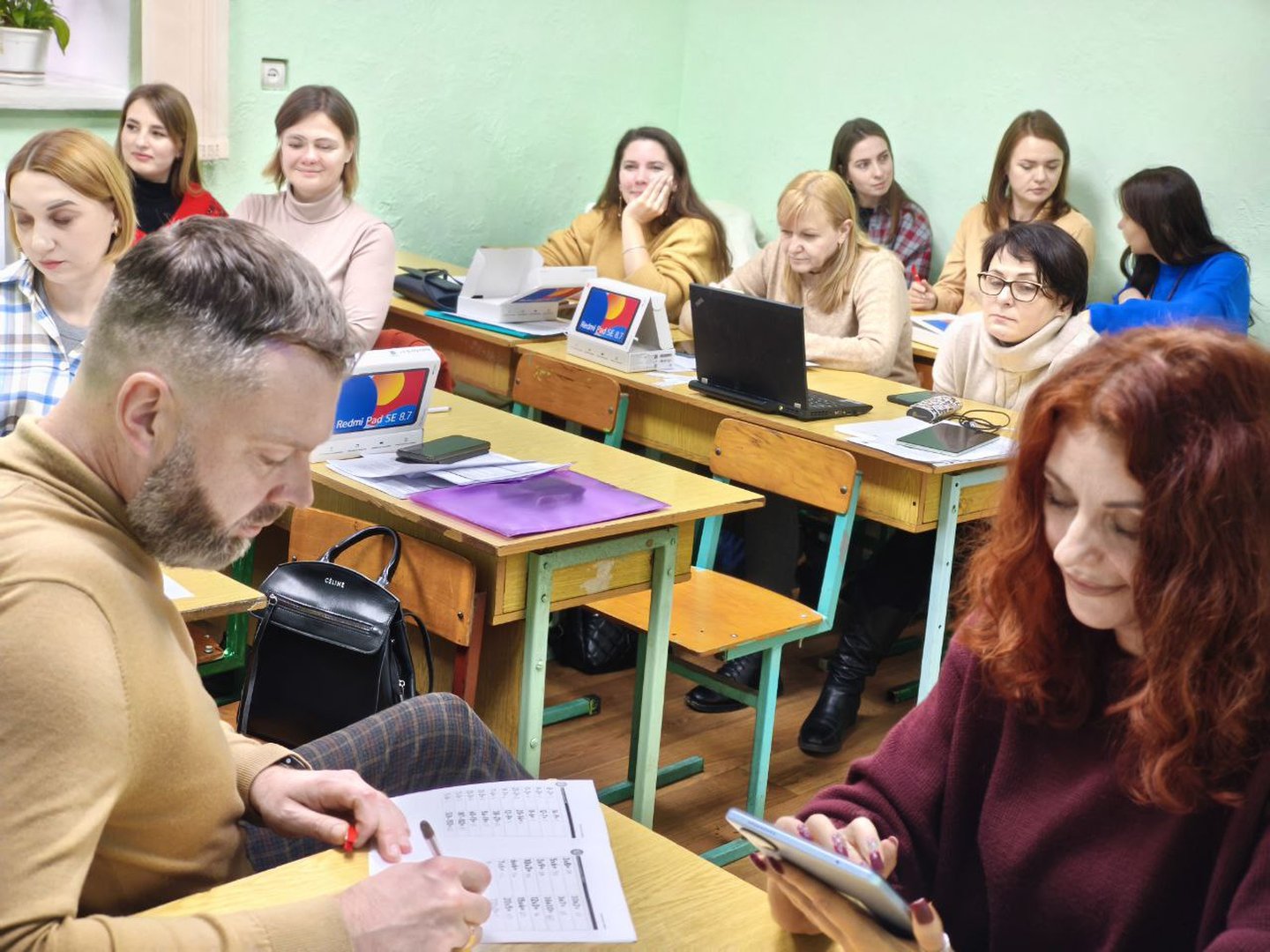
Teachers of intervention schools and Oksana (second from right, bottom), after learning how to implement the Can’t Wait to Learn Ukraine programme.
What were the most important ethical considerations your team had to address, and what is your key recommendation to other researchers for protecting vulnerable participants during research in a war setting?
The most important ethical consideration was finding the right balance between the potential risks the research may pose to participants – both the respondents and the researchers themselves – and the benefits it can bring to children and the Ukrainian education system.
It’s crucial to remain flexible, adapt to the situation, observe carefully, and truly listen – both to the respondents and to the feedback from the research team.
One of the most essential aspects is proper preparation. Researchers need to understand how to act in complex situations, how to respond to psychological or emotional distress that participants might experience, and whom to refer them to if problems arise. They also need to know how to behave in dangerous war-related conditions and be aware of the kinds of actions that could unintentionally violate ethical standards, as well as how to avoid doing so.
No matter how thorough the training, flexibility in the field is key. Every situation is different, and researchers must be ready to respond to challenges in real time. They should always keep participant safety at the centre of their work.